
I’ve Owned an IUL for 15 Years. Here’s How It Has Actually Performed
 Posted in Indexed Universal Life (IUL) last updated on October 8, 2026
After 15 years of owning an IUL, here’s what my actual index interest credits have looked like, including my average IUL return and the full year-by-year historical returns from 2012 to 2026, plus why I’ve never compared its rate of return to the S&P 500.

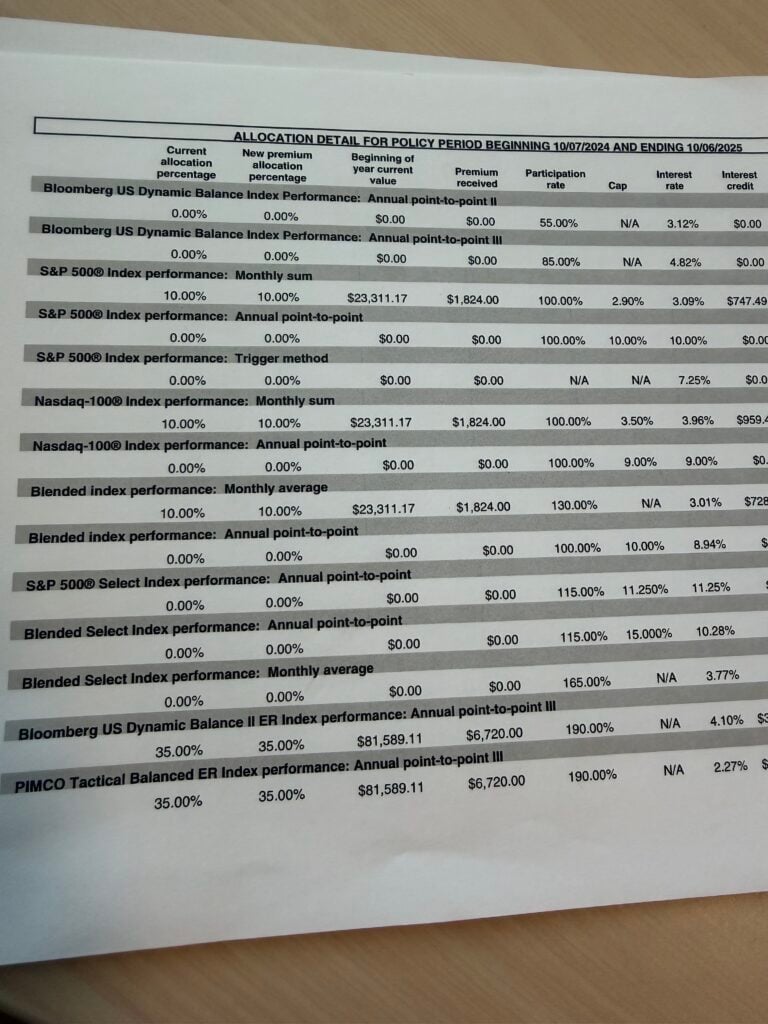
I’ve owned my indexed universal life insurance policy for about 15 years.
During that time, I’ve seen strong crediting years, low crediting years, and a year when my index interest credit was 0%. I’ve also borrowed against my policy to buy a car and used a policy loan as a source of capital for my options trading account.
So rather than writing another article about what an IUL might do based on an illustration, I want to show you my actual IUL historical returns.
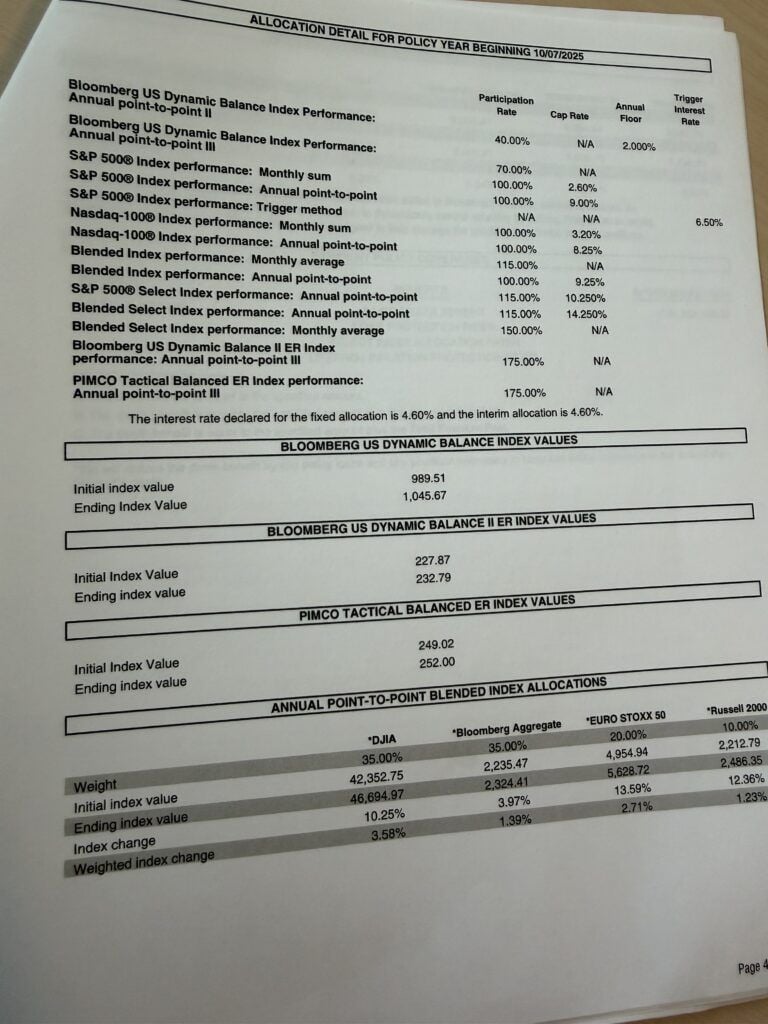
I’ll also explain why I own an IUL, where it fits within my overall financial strategy, how I’ve used the cash value, and the actual annual index interest credits my policy has received from 2012 through 2026.
But first, I want to clear up one of the biggest misconceptions about indexed universal life insurance.
If you’re not yet familiar with how IUL works, here’s a full breakdown of how indexed universal life insurance works before we get into my numbers.
An IUL Is Not a Replacement for the Stock Market
I often see people compare IUL returns with stock market returns and then declare one the winner. I think that’s the wrong comparison.
An IUL is life insurance. It is not a stock market investment, and you aren’t buying shares of the S&P 500 or another index.
I own market investments for market exposure and long-term growth potential, but I own an IUL for other reasons.
With an IUL, the interest credited to the policy is linked to the performance of an external index under the policy’s crediting formula. Depending on the strategy, caps, participation rates, spreads, floors, and other provisions may affect the amount credited. That means I don’t expect my IUL to capture all of the upside of the stock market. And I’m okay with that.
I’m using the IUL to diversify how different parts of my financial strategy behave. If my only objective were to maximize participation in stock market growth, I wouldn’t use an IUL to accomplish it. I’d just invest in the market. I own both because I want them to do different jobs.
Why I’ve Kept My IUL for 15 Years
When I evaluate my IUL, I don’t simply ask, “What rate did it earn this year?”
I look at what the policy contributes to my overall financial plan. So, here are the primary reasons I continue to own it:
Death Benefit Protection
First and foremost, an IUL is life insurance. If I die while my policy is in force, it provides a death benefit to my beneficiaries according to the terms of the contract. That’s a feature my brokerage account doesn’t provide.
The cash value and living benefits are important to me, but they exist within a life insurance contract. I think that distinction gets lost when IUL discussions focus entirely on rates of return.
Access to Cash Value Before Age 59½
I also like having a pool of money that operates under different rules from my qualified retirement accounts.
Subject to the policy’s terms and sufficient available cash value, I can access my policy through withdrawals and policy loans without waiting until age 59½.
Properly structured life insurance can potentially provide tax-advantaged access to cash value. However, withdrawals and loans have to be managed carefully. Loans accrue interest, withdrawals generally reduce policy values, and a policy that lapses or is surrendered with an outstanding loan can create tax consequences.
For me, the important word is flexibility. I don’t want every dollar I’ve accumulated subject to exactly the same rules.
A Potential Volatility Buffer During Market Downturns
One way I think about my IUL is as another potential source of liquidity when markets aren’t cooperating.
Imagine I’m retired and need money for living expenses during a significant market downturn. I could sell investments after they’ve fallen. But that may mean selling more shares at depressed values and leaving fewer shares invested if the market subsequently recovers.
If I have sufficient accessible cash value in my IUL, I may have another choice: access money through the policy rather than selling some of my investments while they’re down.
That doesn’t eliminate risk or guarantee a better outcome. Policy loans have costs and need to be managed properly. But it gives me another option. I think of that as a volatility buffer.
I’m not trying to predict when the market will fall or recover. I’m trying to build enough flexibility into my financial strategy that I have choices when it happens.
A Complement to the Conservative Side of My Portfolio
I also look at my IUL when determining how much risk I want across my overall financial picture.
While you’ll sometimes hear an IUL described as a “bond alternative,” that comparison needs context. An IUL isn’t a bond. The two have completely different risks, costs, liquidity characteristics, tax treatment, and purposes. However, cash value life insurance can potentially complement the conservative side of a portfolio for someone who also needs permanent life insurance.
Again, I’m not asking one financial product to do everything. I’m looking at how all the the pieces work together.
Different Funding Rules Than Qualified Retirement Plans
A 401(k), IRA, and other qualified retirement accounts operate under specific contribution and tax rules. Life insurance operates under a different set of rules.
There isn’t a traditional retirement plan contribution limit or income cap that works the same way as it does for qualified accounts. However, that does not mean someone can simply contribute an unlimited amount to an IUL.
Policy funding is affected by the amount of insurance, underwriting, policy design, and federal tax rules. Overfunding a policy beyond certain limits can also cause it to become a Modified Endowment Contract, or MEC, which changes the tax treatment of distributions and loans. For higher-income individuals who are already maximizing other retirement strategies, those different funding rules can create another planning opportunity.
If you want to understand where life insurance fits alongside traditional retirement accounts, my guide to qualified vs. non-qualified retirement plans breaks down the differences.
Chronic Illness or Long-Term Care Benefits
Depending on the policy and riders selected, an IUL may also provide access to benefits if the insured experiences a qualifying chronic illness or needs long-term care. The availability, qualifications, costs, and structure of these benefits vary by policy and insurer. To me, this is another example of why evaluating an IUL solely on its index crediting rate misses part of the picture.
How I’ve Actually Used My IUL Cash Value
One of the reasons I value my IUL is that the cash value isn’t something I have to wait until retirement to potentially use. I’ve actually accessed it.
I Used My IUL to Finance a Car
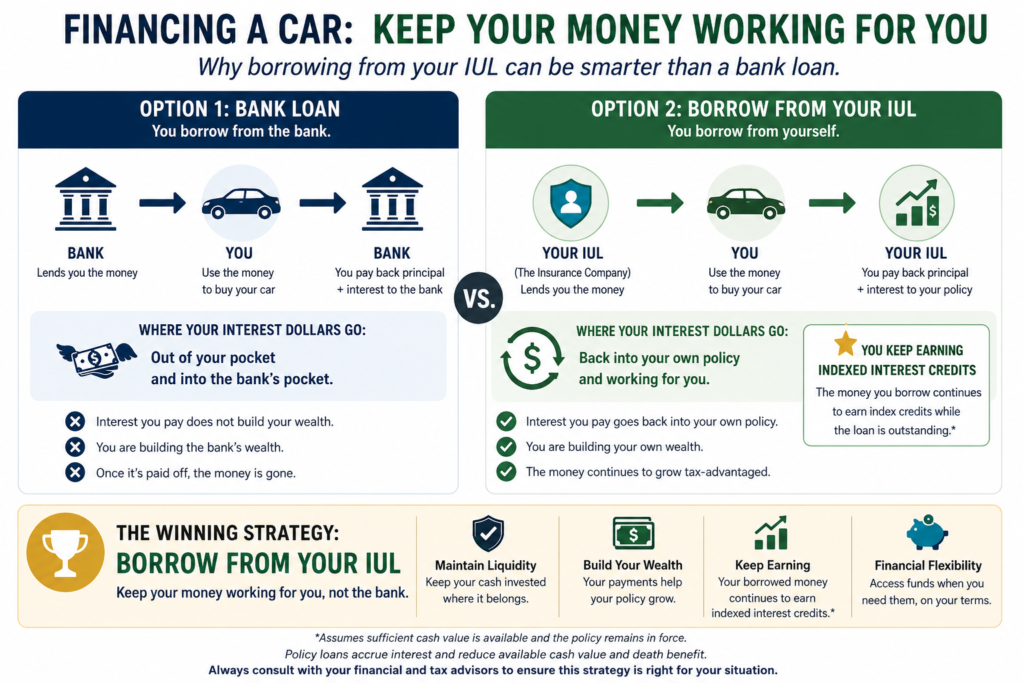
When I purchased a car, I had the option of financing it through a bank. Instead, I borrowed against the cash value of my IUL.
I still had a loan and still had to pay interest. But instead of relying on a traditional auto lender, my policy served as collateral for a loan from the insurance company.
That’s an important distinction. Technically, I wasn’t withdrawing my money and then paying myself interest. The insurer made the loan against my policy’s cash value. What I gained was flexibility.
I had spent years building cash value, and when I needed capital, I was able to access liquidity from the policy without selling my market investments or going through a traditional auto loan. That is exactly the kind of financial flexibility I wanted when I purchased the policy.
I’ve Also Used My IUL for Investment Liquidity
I’ve also taken a policy loan and deployed the proceeds into my options trading account. This is a more advanced strategy and certainly isn’t appropriate for everyone. I use a conservative options strategy aligned with my own risk tolerance.
What makes the strategy interesting to me is how certain IUL policy loans can work.
Depending on the policy and loan provisions, the cash value associated with the borrowed amount may continue to receive interest or index credits under the policy’s terms while the insurer lends against the policy as collateral.
Meanwhile, I can deploy the loan proceeds elsewhere. In my case, I’ve used those proceeds in my options trading account. This gives the capital the potential to work in two different places: through the applicable crediting mechanics inside the policy and through whatever return I may generate with the borrowed funds outside the policy.
But there is no free money here. The policy loan charges interest, and index credits aren’t guaranteed. My options account can make or lose money. Outstanding policy loans also affect policy values and death benefits, and can lead to serious consequences if the policy isn’t managed properly.
I’m comfortable with those risks because I understand what I’m doing and actively manage the strategy. That’s why I don’t view my IUL simply as a place to accumulate cash. I view it as a source of financial flexibility that can give me access to capital when I believe I have a productive use for that capital elsewhere.
My Actual IUL Index Credits From 2012–2026
Now let’s get to the numbers.
Rather than showing you an illustration of what an IUL might earn, I can show you the actual index interest credits my policy has received.
My policy anniversary is October 7. These are my completed annual index interest credits through October 7, 2026.
(These are actual credits from my own policy, not an illustration.)
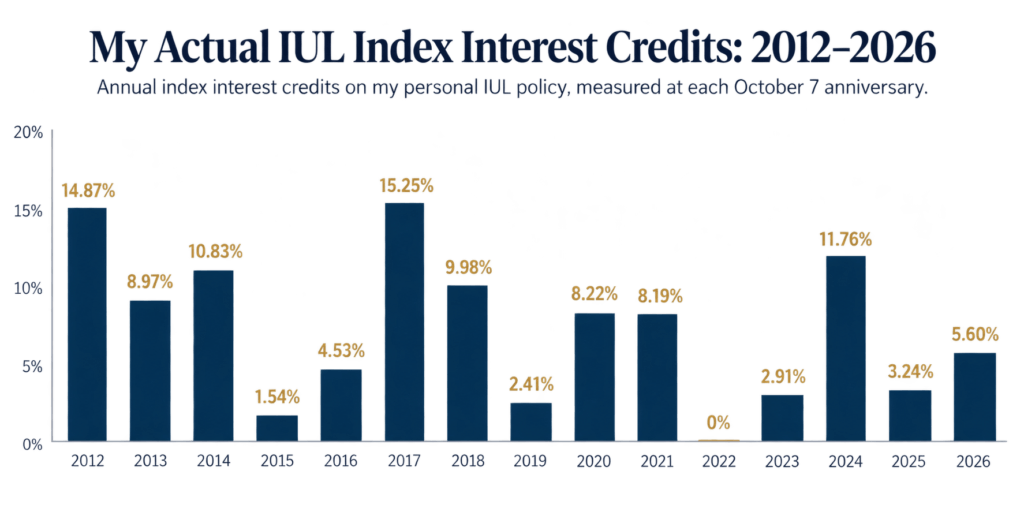
| Policy Anniversary | Index Interest Credit |
| 2012 | 14.87% |
| 2013 | 8.97% |
| 2014 | 10.83% |
| 2015 | 1.54% |
| 2016 | 4.53% |
| 2017 | 15.25% |
| 2018 | 9.98% |
| 2019 | 2.41% |
| 2020 | 8.22% |
| 2021 | 8.19% |
| 2022 | 0.00% |
| 2023 | 2.91% |
| 2024 | 11.76% |
| 2025 | 3.24% |
| 2026 | 5.6% |
| Arithmetic Average | 7.22% |
My Average IUL Return Was 7.22%, But That Number Needs Context
Across these 15 completed annual periods, my arithmetic average index interest credit — the closest thing to what people usually mean by an “IUL rate of return” was 7.22%.
I’m pleased with that history, but I want to be very clear about what that number means.
It does not mean my policy earned a 7.22% annualized return. It is the arithmetic average of the annual index interest credits shown above. That’s different from calculating the net growth of my cash value.
An IUL has insurance costs, policy expenses, and other charges. Policy loans and withdrawals can also affect policy values. So presenting 7.22% as my “investment return” would be misleading.
These are my actual historical index interest credits.
What I Find More Interesting Than the Average
Look at the individual years.
I’ve had several years with double-digit index credits:
- 14.87% in 2012
- 10.83% in 2014
- 15.25% in 2017
- 11.76% in 2024
I’ve also experienced much lower crediting years, including 1.54% in 2015 and 2.41% in 2019.
And then there’s 2022. My index interest credit was 0.00%.
That year is an important part of the story. Under the applicable index strategy in my policy, a negative index result can result in a 0% index interest credit rather than a negative index credit due to the market decline.
That doesn’t mean the policy couldn’t lose cash value that year. Policy expenses and insurance charges still apply, so a 0% index credit is not the same thing as a 0% net policy return.
But this downside crediting characteristic is one of the reasons I own an IUL.
I’m willing to give up some market upside in exchange for financial characteristics that I don’t get from owning stocks directly.
Why I Don’t Compare My 7.22% Average With the S&P 500
It would be easy to take my 7.22% average index credit and put it next to the S&P 500’s return over the same period.
I’m deliberately not doing that. Why?
Because it would reinforce the idea that I bought my IUL as an alternative to investing in stocks. And I didn’t.
Comparing two S&P 500 index funds makes sense because they’re trying to do the exact same thing. But comparing my stock portfolio to my IUL is like comparing apples to oranges…they have completely different jobs.
My investments are built for market growth. My IUL, on the other hand, gives me lifelong insurance coverage, cash protection during market drops, tax advantages, and quick access to capital whenever I need it.
That’s why asking whether an IUL “beats the market” misses the point. I don’t need my IUL to beat my stock portfolio. I need it to do its job.
What 15 Years of Owning an IUL Has Taught Me
After about 15 years of owning my policy, my biggest takeaway isn’t the 7.22% average credit.
It’s the value of giving different parts of my money different jobs.
I want growth, liquidity, life insurance protection, tax diversification, and access to capital.
And I also want options when financial markets aren’t cooperating.
No single financial product gives me everything I want, which is exactly why I don’t believe financial planning should be about finding one “best” investment or product.
The goal is to build a financial strategy in which the pieces complement one another. My IUL is one of those pieces. It has allowed me to accumulate cash value, borrow against that value when I’ve needed capital, maintain permanent life insurance protection, and experience 14 completed annual index-crediting periods without directly investing those policy values in the stock market.
That’s why I still own it.
Is an IUL Right for You?
My experience doesn’t mean everyone should buy an IUL. These are complex, long-term life insurance contracts. They have costs, and they require proper design and funding. Policy performance needs to be monitored, particularly when loans or withdrawals are involved.
And if someone is primarily looking for maximum participation in stock market growth, an IUL isn’t designed to accomplish that objective. But if you need permanent life insurance and also value cash-value accumulation, liquidity, tax diversification, potential living benefits, and another source of capital outside traditional retirement accounts, an IUL may be worth evaluating as one component of a broader financial strategy.
The question isn’t: “Is an IUL better than the stock market?”
The better question is: “What do I need this money to do, and does an IUL fill a gap in my overall financial strategy?”
That’s the question I’ve asked myself for the last 15 years.
And for me, the answer has been yes.
Frequently Asked Questions About IUL Returns and Cash Value
What is an Average Return On an IUL?
An IUL doesn’t have a guaranteed market-style rate of return. Index interest credits depend on the policy’s crediting strategy and may be affected by caps, participation rates, spreads, floors, and other provisions. Policy charges also affect actual cash-value performance. Rather than focusing on one assumed IUL rate of return, evaluate the policy under multiple crediting scenarios and monitor actual performance over time.
Can an IUL Lose Money When the Stock Market Falls?
With a 0% floor on an applicable index-crediting strategy, a negative index result generally won’t create a negative index credit solely because the index fell. However, a 0% index credit does not mean your cash value cannot decline. Insurance costs, policy expenses, loans, withdrawals, and other factors can reduce policy values.
Can I Borrow Money from My IUL?
If sufficient cash value is available, an IUL may allow you to take a policy loan using the policy’s cash value as collateral. Loan provisions and interest rates vary by contract. Loans generally reduce available policy values and death benefits and should be monitored carefully.
Are IUL policy loans tax-free?
Policy loans from a properly structured non-MEC life insurance policy generally aren’t treated as taxable income when taken, but the tax treatment can change under certain circumstances. A policy that lapses or is surrendered with outstanding loans may create taxable income, and loans from a Modified Endowment Contract are subject to different tax rules. Consult a qualified tax professional regarding your individual situation.
Is an IUL better than investing in the S&P 500?
They’re designed for different purposes. An IUL is a life insurance contract with index-linked interest-crediting features, whereas investing in an S&P 500 fund provides direct exposure to the index’s companies. An IUL shouldn’t be evaluated simply as a substitute for stock market investing.
Can I use IUL cash value before retirement?
Potentially, yes. Subject to the policy’s terms and available cash value, withdrawals and policy loans can provide access to cash value without the age-based distribution rules that apply to certain qualified retirement accounts. However, accessing cash value can affect policy performance and should be planned carefully.
Final Thoughts on My 15-Year IUL Experience
There are plenty of hypothetical IUL illustrations available, but I wanted to show you something different.
These are my numbers, and these are some of the ways I’ve actually used my policy. And these are the reasons an IUL continues to have a place within my financial strategy after about 15 years of ownership.
My experience isn’t a promise of what your policy will do. Your results could be substantially different. But I hope sharing my experience gives you a better framework for evaluating IUL: not as a competitor to your investment portfolio, but as a financial tool that may serve a different purpose alongside it.
If you’d like to determine whether an IUL has a legitimate role within your own financial strategy, we can evaluate it in the context of your investments, retirement accounts, tax exposure, insurance needs, liquidity, and long-term goals.
The goal isn’t to own an IUL. The goal is to build the right financial strategy.
Disclosure: The historical figures shown in this article are index interest credits from my personal indexed universal life insurance policy and are provided for educational purposes. They are not representative of the results another policyholder should expect and do not represent net policy returns. Actual policy performance depends on policy design, premiums, insurance costs, expenses, crediting terms, loans, withdrawals, and other factors. Index credits are not guaranteed, and past results do not predict future results. Policy loans accrue interest and reduce available policy values and death benefits. Loans and withdrawals may have tax consequences, particularly if a policy lapses, is surrendered, or is classified as a Modified Endowment Contract. This article is not tax or legal advice.


