
Can You Get a $2 Million Dollar Life Insurance Policy With No Medical Exam?
 Posted in Life Insurance last updated on October 14, 2026
Yes. It is possible to get a $2 million life insurance policy without a medical exam, and applicants in good health may qualify through accelerated underwriting without blood work, urine samples, or a traditional paramedical exam.
In fact, $2,000,000 is no longer unusually high for accelerated underwriting. Some insurers now consider qualifying applicants for several million dollars of coverage without an exam.
Key Takeaways
- No medical exam does not mean no underwriting. The insurance company still looks at your health, medications, lifestyle, financial information, and other risk factors.
- No-exam coverage is not the same as guaranteed-issue life insurance. You still have to qualify.
- $2 million of coverage must also be financially justified based on your income, assets, debts, business needs, or other financial obligations.
- The company showing the lowest initial quote is not always the company that will give you the lowest final premium; your underwriting classification matters.
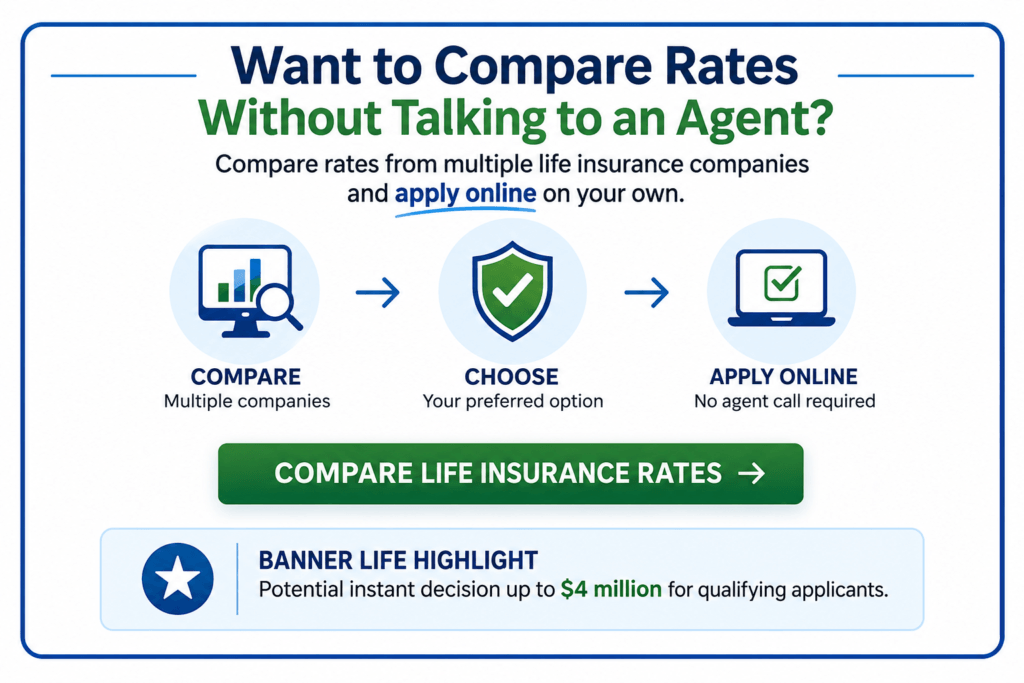
Our self-service quoting tool lets you compare rates from multiple life insurance companies and apply online without speaking with us first.
We often start with Banner Life for relatively healthy applicants because it is typically among the more competitively priced term options we see and may provide an instant underwriting decision for qualifying applicants.
Prefer another company? You can compare your options and apply online with another available carrier through the same quoting tool.
Quotes are estimates and do not guarantee coverage, underwriting classification, final premiums, or an instant decision. Underwriting requirements and online application availability depend on the carrier and applicant.
What Does No Medical Exam Life Insurance Really Mean?
The life insurance application process has changed considerably. Traditionally, applying for a large life insurance policy almost automatically meant completing a paramedical exam. Someone would come to your home or office, measure your height and weight, take your blood pressure, and collect blood and urine samples.
Today, many insurers use accelerated underwriting. Instead of automatically ordering a medical exam, the insurer may first review available electronic data to determine whether it has enough information to make an underwriting decision.
That information may include:
- Your application and health questionnaire
- Prescription drug history
- Electronic health records
- Medical Information Bureau information
- Motor vehicle records
- Prior insurance application information
- Financial information
- Public records and other permitted third-party data
The National Association of Insurance Commissioners (NAIC) explains that accelerated underwriting can use external data, analytics, and modeling to supplement the application process and potentially eliminate the need for a traditional physical exam.
This is why I always tell clients that ‘no exam’ isn’t a separate policy type. It’s really just a streamlined way for insurers to approve standard term life insurance.
No Exam Does Not Mean Guaranteed Issue
Guaranteed-issue life insurance is a different type of policy that generally involves little or no medical underwriting and usually provides relatively small death benefits. That is not what we’re talking about here.
A $2 million no-exam policy is still underwritten. You must qualify medically and financially. The insurer is simply determining whether it has enough information to make an offer without ordering an exam.
How Does Accelerated Underwriting Work?
Think of accelerated underwriting as the insurance company asking:
“Do we already know enough about this applicant to make a decision?”
If the answer is yes, you may receive an underwriting decision without completing an exam.
If the answer is no, the insurer may request additional information.
Banner Life provides a good example of how this works. Their accelerated underwriting process can route applicants through different underwriting paths based on what it discovers.
Instant Decision
For qualifying applicants, Banner can potentially make a decision based on digitally collected information without an exam. Its current accelerated-underwriting program considers qualifying applicants ages 20–60 for coverage amounts up to $4 million.
Exam-Free Underwriting
Someone who doesn’t receive an instant decision may still qualify without completing a traditional medical exam. Additional medical records, such as an attending physician statement, may be needed.
Full Underwriting
If Banner needs more information, the application can proceed to full underwriting, and additional requirements may be requested.
Can Minor Health Problems Still Qualify for No-Exam Life Insurance?
Potentially, yes. You don’t necessarily need a flawless medical history to qualify for accelerated underwriting.
Companies like Banner include health conditions such as controlled cholesterol and hypertension among those that may potentially qualify for accelerated underwriting. Other factors, including your build, medications, family history, driving record, and overall medical history, can still affect the decision.
Someone taking medication for controlled high blood pressure may assume they won’t qualify and choose a more restrictive life insurance product. That may be completely unnecessary.
Conversely, someone with a more complex medical history may submit an application directly to the company with the lowest online quote, unaware that another insurer might view the condition more favorably.
Price matters, but underwriting fit matters first.
How Much Does a $2 Million Life Insurance Policy Cost?
We’re often asked: ‘How much is a $2 million life insurance policy?
As much as we’d love to give you a single dollar amount, there isn’t one set price. The monthly cost of a $2 million life insurance policy depends on several key factors, including:
- Personal Information: Age, sex, occupation, and hobbies
- Health Profile: Health status, family medical history, prescription medications, and tobacco/nicotine use
- Policy Details: Coverage amount, term length, and underwriting classification
- Lifestyle & Safety: Driving history
Someone who purchases $2 million of coverage at 30 will generally pay considerably less than someone purchasing the same policy at 50. Younger, healthier applicants also tend to qualify for lower rates.
Sample Rates for a $2 Million Term Life Insurance Policy
Here is a simple illustration of how age can affect the cost of $2 million of coverage.
Sample monthly premiums for a healthy non-smoking applicant purchasing a 20-year level term life policy in California: ( I used Banner Life and Pacific Rates)
| Age | Male | Female |
| 30 | $58.79 | $39.2 |
| 40 | $91.23 | $72.92 |
| 50 | $251.53 | $182.97 |
| 60 | $751.08 | $521.68 |
Rates are examples only and are not guaranteed. Actual premiums depend on the carrier, state, health history, underwriting classification, policy features, and other factors.
How Does the Coverage Amount Affect the Premium?
It is also helpful to see what happens when you change the death benefit rather than the applicant’s age.
Sample monthly premiums for a healthy 40-year-old non-smoker purchasing a 20-year term policy:
| Coverage Amount | Male | Female |
| $1 Million | $48.15 | $39.90 |
| $1.5 Million | $68.85 | $56.07 |
| $2 Million | $91.23 | $72.92 |
| $2.5 Million | $112.13 | $89.24 |
| $3 Million | $135.34 | 106.62 |
One thing consumers sometimes find surprising is that doubling the death benefit does not necessarily double the premium.
Life insurance companies price policies in coverage bands, and the cost per $1,000 of coverage can change at larger death benefits. That is why I recommend comparing nearby amounts such as $1.5 million, $2 million, and $2.5 million rather than automatically choosing a round number before seeing the actual cost.
A life insurance calculator can help estimate whether a $2 million policy fits your needs, but it can’t predict the final underwriting rate an insurer will offer.
The Lowest Quote Is Not Always the Lowest Final Premium
When you run an initial life insurance quote, the price is based on the health class selected for the estimate. Your final rate may be different after underwriting.
Say Company A quotes you $85 a month, and Company B quotes $95. At first, you will think that Company A looks more affordable. But if Company A ultimately offers you a lower health class while Company B approves you at a better rate class, Company B could actually end up costing less.
It helps to break it down into two numbers:
Quoted rate: What you might pay if everything goes perfectly.
Underwritten rate: The actual price the company offers after checking your records.
This difference really matters if you have any pre-existing conditions, take regular medications, or have a family history of health issues. If you’re completely healthy, picking the lowest initial quote works fine. But if your health history is a bit more complicated, finding an insurer with favorable guidelines is much more important than chasing the lowest starting price.
Which Companies Offer $2 Million of Life Insurance Without an Exam?
There’s no single “best” company for everyone. When looking for a larger $2 million term policy, here are five top carriers we routinely evaluate for exam-free coverage:
Banner Life
Through its OPTerm product, Banner offers multiple term lengths along with an expanded accelerated underwriting program. Applicants ages 20–60 may qualify for up to $4 million in coverage without a medical exam, while older applicants may have exam-free options at lower coverage amounts.
Depending on your information, you might receive an instant decision, standard exam-free approval, or a request for traditional underwriting if more health details are needed.
For relatively healthy applicants, Banner is often one of the first companies we consider because of its competitive term pricing and streamlined underwriting process. You can run a quick comparison against other top insurers on our site to see how their rates stack up.
Compare Banner Life Rates & Apply Online →
Lincoln Financial
Lincoln is another strong carrier for larger term policies and accelerated underwriting.
They are a great alternative if Banner isn’t the right fit, or if Lincoln’s guidelines happen to lean more favorably in your direction. When applying for $2 million in coverage, the real question isn’t just if Lincoln offers that amount; it’s whether their underwriting team evaluates your specific health and lifestyle history better than other carriers.
Protective Life
Protective is frequently competitive for term life insurance and is another company worth comparing for larger death benefits.
Beyond great rates, Protective is worth comparing if you care about specific policy features and design.
Pacific Life
Pacific Life is another carrier we consider for larger term policies because of its streamlined underwriting options. What sets them apart is their safety net. If you don’t quite meet the strict criteria for instant approval, they transition you into alternative underwriting options rather than forcing you to restart the process.
Prudential
Prudential can be particularly worth considering when an applicant has a more complicated medical or lifestyle history. Realistically, not every shopper meets the flawless health criteria required for fast-track underwriting. Factors such as past medical conditions, ongoing medications, height-to-weight ratio, and lifestyle habits are evaluated differently by each insurer. Prudential excels at handling these real-world health details, making them essential when simple online quote engines don’t tell the whole story.
Which Life Insurance Company Should You Choose?
If you have a clean health history, starting your search with Banner makes a lot of sense. However, the lowest initial quote shouldn’t be your only deciding factor.
Consider a 42-year-old non-smoking executive in 20-year term coverage to protect his mortgage and family. He is generally healthy, but takes daily medication for controlled cholesterol. A single cholesterol prescription won’t automatically trigger a medical exam because Banner’s guidelines specifically allow controlled cholesterol to qualify for fast-track, exam-free underwriting. If their rates align with his profile, applying directly with Banner is a great choice.
However, if he also manages sleep apnea or takes multiple prescriptions, finding the carrier willing to give him the best health rating becomes much more important than saving a few dollars on an initial quote.
Ultimately, on paper two carriers might advertise identical starting rates, but in practice your final price depends on how each insurer views your health history. That is the difference between shopping for an advertised quote and shopping for an actual underwriting outcome.
Who Might Need $2 Million of Life Insurance?
A $2 million life insurance policy may sound like a lot of coverage, but it can make sense when your family or business would face a significant financial loss if you died.
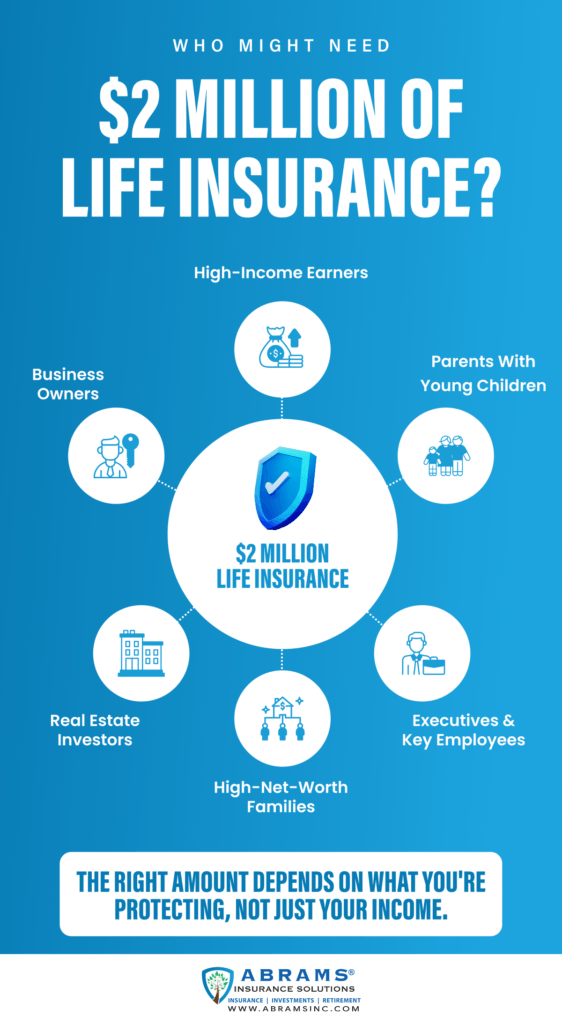
The amount you need depends on more than your income. Your mortgage payments, debts, children, business obligations, existing life insurance, and assets should all be part of the calculation.
People who may need $2 million of life insurance include:
- High-income earners: If your family depends on your income, replacing 10 or 15 years of earnings can quickly create a seven-figure insurance need.
- Parents with young children: Your policy may need to replace income for many years while also helping with the mortgage, childcare, education, and other family expenses.
- Business owners: Coverage may be needed to fund a buy-sell agreement, address business debts, provide liquidity, or protect both your family and business partners.
- Business executives and key employees: A company may purchase key person life insurance when the loss of an owner, executive, salesperson, or other important employee could create a substantial financial loss.
- Real estate investors: A large real estate portfolio can also mean significant debt. Life insurance can provide liquidity to help family members or business partners manage those obligations without being forced to sell properties quickly.
- High-net-worth families: Life insurance may be part of an estate or legacy strategy to provide liquidity, equalize inheritances, replace wealth, or help address estate tax obligations, when applicable.
- People who have outgrown their existing coverage: Maybe you purchased $1 million of life insurance several years ago, but since then your income increased, you bought a larger home, had children, or started a business. You may be able to add another policy rather than replacing the coverage you already have.
How Do You Estimate How Much Life Insurance You Need?
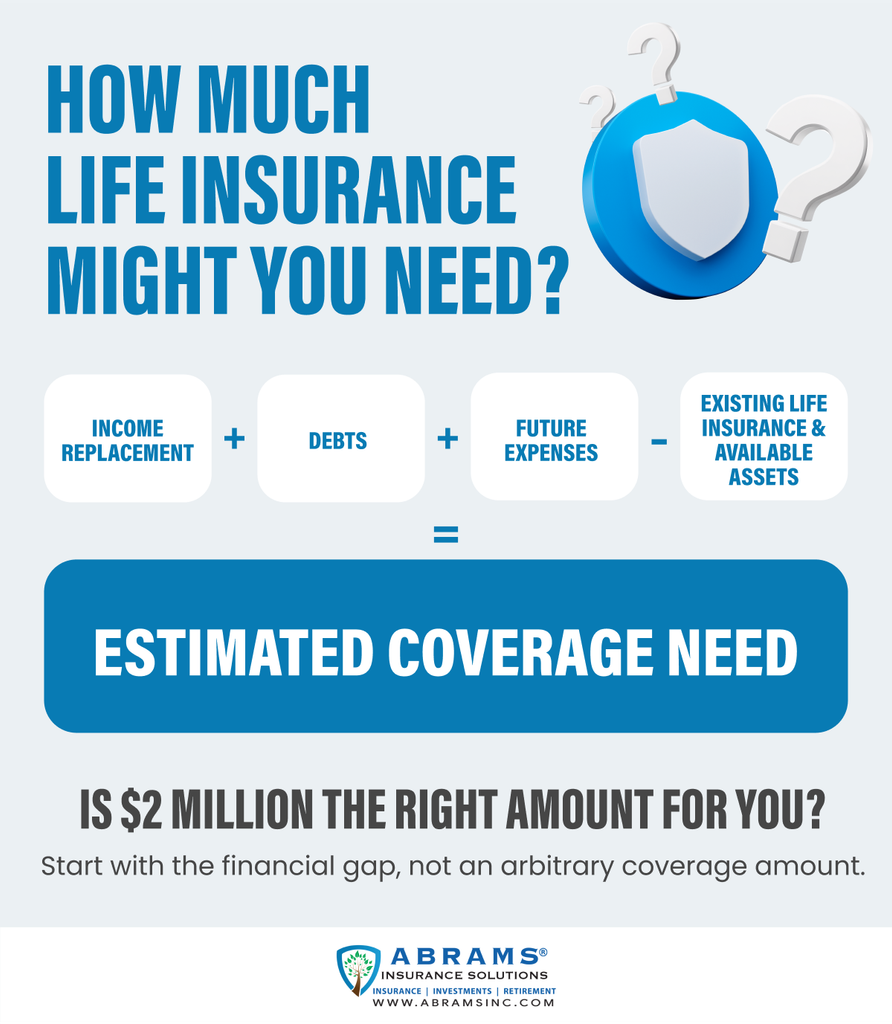
Rather than starting with an arbitrary number, start with the financial gap your death would leave behind.
A simple starting point is:
Income replacement + debts + future expenses − existing life insurance and assets available for those needs = estimated coverage need
For example, replacing several years of income while also accounting for a mortgage, children’s education, and other financial obligations can quickly push the need into the seven figures.
This isn’t a substitute for a complete life insurance needs analysis. Still, it can help you determine whether $2 million is too much, too little, or a reasonable amount of coverage for your situation.
Who Can Qualify for a $2 Million Life Insurance Policy?
Needing $2 million of coverage and qualifying for $2 million are two different things.
In addition to evaluating your health, the insurance company will want to make sure the amount you’re applying for makes financial sense. This is known as financial underwriting.
For income replacement, insurers generally look at your age and annual income. Younger applicants can usually qualify for a larger amount because they have more years of earning ahead of them. But income isn’t the only factor insurers may consider. Depending on the purpose of the policy, they may also look at:
- Your existing life insurance
- Assets and net worth
- Outstanding debts
- Business ownership and financial obligations
- Buy-sell or key person insurance needs
- Estate and legacy planning needs
- Other life insurance applications currently pending
There is no single income requirement that automatically qualifies someone for a $2 million policy. Two people earning the same amount could reasonably qualify for different amounts of coverage depending on their age, existing insurance, financial responsibilities, and reason for purchasing the policy.
Simply put, you need to qualify for both the amount of life insurance and the policy itself.
Frequently Asked Questions
How Much Income Do You Need to Qualify for a $2 Million Life Insurance Policy?
There is no single income requirement for a $2 million life insurance policy. Insurers generally consider your age, income, existing coverage, net worth, debts, and the purpose of the insurance when determining how much coverage can be financially justified.
How Much Does a $2 Million Life Insurance Policy Cost Per Month?
The cost depends on your age, sex, health, tobacco or nicotine use, term length, and underwriting classification. A healthy applicant in their 30s or 40s may pay considerably less than someone purchasing the same coverage in their 50s or 60s.
How Long Does It Take to Get Approved for a $2 Million Life Insurance Policy?
Accelerated underwriting can shorten the approval process. Some qualifying applicants may receive a decision quickly, while others may require electronic health records, physician records, an exam, or additional underwriting. The timeline depends largely on the insurer and whether additional information is needed.
Can You Have Multiple Life Insurance Policies That Add Up to $2 Million?
Yes. You can own multiple life insurance policies that total $2 million or more. For example, you could have two $1 million policies with different term lengths. Insurers will consider your total existing and pending coverage when determining how much life insurance you can financially justify.
Can Seniors Qualify for a $2 Million Life Insurance Policy?
Yes, seniors may qualify for a $2 million life insurance policy, depending on their health, age, and financial justification. Policyholders can use larger policies for estate planning, business interests, debt, or legacy needs. Older applicants also generally face higher rates and may have additional underwriting requirements.
Can an Unemployed Person Qualify for a $2 Million Life Insurance Policy?
Yes, an unemployed person may qualify for $2 million in life insurance if they can justify the coverage on financial grounds. Insurers may consider household income, assets, previous earnings, business interests, and the economic value of a non-working spouse when determining an appropriate coverage amount.
Is a $2 Million Life Insurance Payout Taxable?
Generally, no. Beneficiaries typically receive life insurance death benefits free of federal income tax. However, exceptions can apply, and estate taxes may be relevant depending on the policy’s ownership and the size of the estate. You should review complex cases with a qualified tax or estate-planning professional.
Final Thoughts on Getting $2 Million of Life Insurance Without an Exam
Getting a $2 million life insurance policy without a medical exam is more accessible than many people realize. Accelerated underwriting has made it possible for many qualified applicants to obtain substantial coverage without the traditional exam process.
The key is finding the right company for your situation. If you’re relatively healthy, you may be able to compare rates and handle much of the process online. If your health history is more complicated, comparing underwriting guidelines before applying can be just as important as comparing premiums.
Ultimately, the goal isn’t simply to avoid a medical exam. It’s about getting the right amount of life insurance coverage from a company that fits your health, financial needs, and budget.
If you’re ready, you can compare rates from multiple life insurance companies and apply online. If you’d rather have us compare the options for you, we’re here to help.



4 Comments
Brian Fossick
I was wondering if you would contact me via email. I would like to get a 2 million dollar life insurance policy for my two adult children.
Chris Abrams
Yes. Bennett from my team will reach out to you.
Adam greenly
I was looking for a whole life insurance policy I believe just unsure about what my options are.
Chris Abrams
Hi Adam: We have lots of options depending on what you are looking for. Feel free to reach out at 858-703-6178 or info@abramsinc.com and I will email you as well.