
Kidnap and Ransom Insurance: What It Is and What It Covers
 Posted in Health & Protection Insurance last updated on March 11, 2026
Every year, thousands of business travelers, executives, and humanitarian workers head to parts of the world where kidnapping and extortion are not hypothetical risks. They are documented, recurring realities. For those caught in the wrong place at the wrong time, the financial and logistical consequences can be devastating and nearly impossible to navigate without professional support.
Kidnap and ransom insurance (also called K&R insurance or KR&E coverage) protects individuals, families, and organizations against the costs associated with kidnapping, extortion, wrongful detention, and hijacking. Beyond financial reimbursement, it also provides access to professional crisis management teams who know how to handle these situations from the first call to the final resolution.
What many people don’t know is that K&R insurance goes well beyond covering the ransom itself. A comprehensive policy addresses the full scope of an incident, from private negotiators and crisis response teams to psychiatric care, legal fees, rehabilitation, and lost income.
This guide walks through everything you need to know, including who needs it, what it covers, how to choose the right policy, and how to get a quote.
Quick Summary
Kidnap and ransom insurance (K&R insurance) protects individuals and organizations from the financial costs of kidnapping, extortion, wrongful detention, and hijacking.
Policies typically reimburse ransom payments and provide access to professional crisis response teams, negotiators, medical care, legal support, and other recovery services.
K&R coverage is commonly used by executives, international travelers, humanitarian workers, and companies operating in higher-risk regions.
Table of Contents
- Who Needs Kidnap and Ransom Insurance?
- Countries With the Highest Kidnapping Risk for Travelers
- What Does Kidnap and Ransom Insurance Cover?
- What Kidnap and Ransom Insurance Usually Doesn’t Cover
- Factors to Consider When Choosing a Kidnapping Insurance Policy
- How Much Does Kidnap and Ransom Insurance Cost?
- How to Get Kidnapping Insurance?
- FAQs
Who Needs Kidnap and Ransom Insurance?
Anyone whose work, lifestyle, or travel patterns put them at elevated risk should consider K&R insurance. This coverage protects a wider range of people than most expect.
Individuals and Families
The most common candidates are executives and business travelers who regularly visit high-risk regions, high-net-worth individuals and their families who may be targeted based on their public profile or perceived wealth, and professionals working in vulnerable fields such as journalism, humanitarian aid, and diplomatic services.
Businesses and Organizations
If your organization sends employees to countries with elevated kidnapping or extortion risk, K&R coverage is a core part of responsible risk management. It protects your people, limits your legal exposure, and ensures your team has professional crisis support if something goes wrong.
Universities with international programs, NGOs operating in conflict zones, and companies in industries like energy, mining, and maritime are among the most frequent buyers of corporate K&R policies.
Geographic Trigger to Keep in Mind
Most K&R policies are triggered by travel outside your country of permanent residency. If your exposure is primarily domestic, this coverage may not apply. For organizations and individuals operating internationally, however, it is one of the few insurance products specifically built for the complexity and urgency of a kidnapping or extortion event.

Not Sure If You Need It?
The general rule is simple. If you or your employees are traveling to any region with a State Department Level 3 or Level 4 travel advisory, kidnap and ransom insurance is worth serious consideration.
Countries With the Highest Kidnapping Risk for Travelers
Kidnapping risk is not evenly distributed around the world. While incidents can occur anywhere, certain countries and regions consistently record higher rates of kidnapping, extortion, and wrongful detention targeting foreign nationals. Understanding where the risk is concentrated is an important first step in determining whether K&R coverage is right for your situation.
The following countries are among those most frequently cited for elevated kidnapping risk for travelers and foreign workers:
- Mexico
- Colombia
- Venezuela
- Nigeria
- Haiti
- Somalia
- Afghanistan
- Iraq and Syria
- Mali and Burkina Faso
- Libya
Note: This list is not exhaustive. Kidnapping risk can shift quickly based on political developments, regional instability, and other factors. Before traveling internationally, always consult the U.S. State Department Travel Advisory page for the most current risk ratings by country. Any destination rated Level 3 or Level 4 warrants a serious conversation about K&R coverage before you go.
What Does Kidnap and Ransom Insurance Cover?
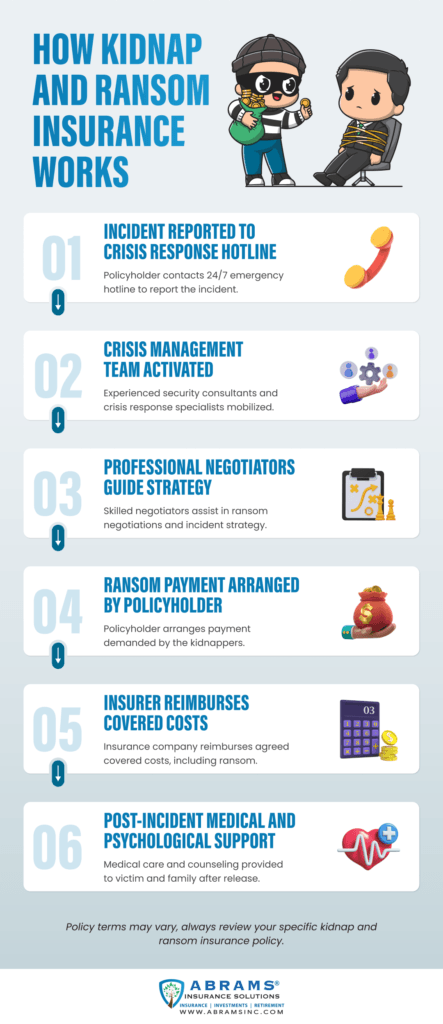
Many people believe K&R insurance only reimburses a ransom payment. In reality, a comprehensive policy supports you throughout the incident lifecycle, from the initial threat through long-term recovery.
A well-structured policy typically includes:
Additional Benefits
Depending on the policy, coverage may also include reward payments to informants, child care expenses resulting directly from the event, asset protection for interest on loans taken to meet ransom demands, and funeral and repatriation expenses in the event of death.
Ransom Reimbursement
Covers the cost of the ransom paid to kidnappers (these policies usually reimburse you after the payment is made rather than paying upfront).
Crisis Response and Negotiation
Policies provide access to professional crisis management teams and approved private negotiators who work directly with the policyholder to manage the situation. This includes strategic guidance, communication support, and on-the-ground coordination throughout the incident.
Personal Accident Benefits
If the kidnapped individual suffers serious physical harm during the event, the policy provides a lump sum payment covering permanent disability, loss of limbs or sight, or death.
Medical and Psychiatric Care
Coverage includes independent medical, psychiatric, and legal care both before and after release, typically for up to 12 months following the incident. Rehabilitation expenses for the victim and immediate family members are also covered for a defined period after release.
Loss of Income
The policy covers the salary of the kidnapped person during the incident, as well as the salaries of any employees specifically designated to assist in negotiation and recovery efforts.
Travel and Accommodation Expenses
Costs for travel and accommodations incurred at the crisis response team’s advice are covered throughout the event.
Public Relations Costs
If the incident becomes public or media attention becomes a factor, the policy covers the expenses of a PR consultant or interpreter to help manage communications.
Security and Specialized Equipment
Depending on the crisis response team’s recommendation, coverage can extend to security personnel, communication and recording equipment, and any advertising costs resulting from the incident.
Legal Liability
If legal claims arise from the incident, such as a lawsuit brought by the victim or their family against an employer, legal liability coverage provides an additional layer of financial protection.
What Kidnap and Ransom Insurance Usually Doesn’t Cover
While kidnap and ransom insurance provides broad protection, it does not cover every situation. Like most insurance policies, K&R coverage includes specific exclusions that define when benefits may not apply. Understanding these limitations can help you avoid surprises if a crisis occurs.
Common exclusions may include:
- Incidents that occur within the policyholder’s country of permanent residence
- Travel to countries subject to U.S. government sanctions or restrictions
- Fraudulent ransom demands or staged kidnapping incidents
- Events involving illegal or criminal activity by the insured person
- Acts of war or military conflict in certain regions
Because policy terms vary between insurers, it is important to review the exact wording of your coverage and understand any geographic or activity-related limitations before purchasing a policy. Working with an experienced insurance advisor can help ensure the policy matches your travel patterns and risk exposure.
Factors to Consider When Choosing a Kidnapping Insurance Policy
Not all K&R policies are built the same. Coverage terms, limits, and included services vary significantly between providers, so it is worth evaluating each of the following before committing to a policy.

Coverage Limits
Consider the likely ransom demand in the regions where you or your employees will be traveling. Policies with low coverage ceilings may not provide sufficient funds to meet a real-world demand, particularly in high-risk countries where ransom amounts can reach into the hundreds of thousands or even millions of dollars. Make sure the limit aligns with your actual exposure.
Geographic Scope
Confirm exactly where the policy applies. Some policies have geographic exclusions that limit or eliminate coverage in certain countries, particularly those under U.S. sanctions or with the highest State Department travel advisory ratings. Also, clarify whether the policy covers both personal and work-related travel, as some policies distinguish between the two.
Crisis Response Services
The quality of the crisis response team included in the policy is just as important as the financial coverage itself. Look for policies that provide 24/7 access to experienced negotiators, security consultants, and crisis management professionals. In a kidnapping situation, having the right people on the phone immediately can make a significant difference in how the event unfolds.
Policy Exclusions
Beyond geographic limitations, review the fine print carefully for other exclusions. Common ones include incidents involving travel to sanctioned countries, events that occur within your country of permanent residency, and coverage that expires after a set number of days during a trip. Understanding what is not covered is just as important as understanding what is.
Confidentiality Requirements
This is one of the most overlooked aspects of K&R insurance. Most policies require that the existence of the coverage be kept strictly confidential. Disclosing that you or your organization holds a K&R policy can void coverage entirely, as it increases the risk of fraudulent claims and makes policyholders a more attractive target. Employees covered under a corporate policy are often unaware that the coverage exists for this reason.
Insurer Reputation and Financial Stability
K&R insurance is a specialty product, and not all insurers have equal experience handling these claims. Look for providers with a demonstrated track record in crisis management, a strong financial stability rating, and global reach. An insurer with local expertise in the regions you operate in is a meaningful advantage when a situation requires fast, informed action.
How Much Does Kidnap and Ransom Insurance Cost?
The cost of a K&R policy depends on several factors working together: the coverage limit you need, the number of people being insured, the regions where coverage applies, and the scope of crisis response services included. That said, it is a more accessible product than many people expect.
Individual and Family Policies
For personal coverage focused on non-hazardous international travel, a $5,000,000 policy typically runs around $2,000 per year. Basic policies with lower coverage limits can be found for under $1,000 annually. Premiums increase significantly for travel to high-risk regions, where the likelihood of an incident is materially higher, and the cost of crisis response is greater.
Corporate Policies
Business policies are priced based on the organization’s size, the number of employees covered, the nature of their work, and the regions in which they operate. Companies in high-risk industries such as energy, mining, maritime, and humanitarian aid typically pay higher premiums to reflect their elevated exposure. Coverage limits for corporate policies often range from $5,000,000 to $10,000,000 or more, depending on the individuals’ profiles.
Travel Insurance vs. Dedicated K&R Coverage
Some standard travel insurance policies include a K&R rider, but the ransom coverage limits on these plans are typically low, often between $5,000 and $10,000. Security experts generally recommend a minimum of $50,000 in ransom coverage for individual travelers, with higher limits for executives, high-net-worth individuals, and corporate teams.
A dedicated K&R policy provides substantially higher coverage limits and, critically, access to professional crisis management teams that a standard travel policy does not include. If your risk exposure is genuine, a travel insurance add-on is not a substitute for purpose-built K&R coverage.
Bottom Line
Because every policy is customized to the buyer’s specific risk profile, the figures above are a starting point rather than a fixed price. The most accurate way to understand what a policy will cost for your situation is to request a customized quote.
How to Get Kidnapping Insurance?
Because K&R insurance is a specialty product, the process differs from that of standard insurance. There is no instant online quote. Every policy is customized to the applicant’s specific risk profile, so the process involves a few steps before coverage is issued.
Step 1: Risk Assessment
The insurer will conduct an assessment to evaluate the nature and level of risk associated with your situation. This includes reviewing travel patterns, business activities, the regions involved, and any prior security incidents. The results of this assessment inform the coverage terms, limits, and premiums offered.
Step 2: Policy Application
You will need to provide detailed information about yourself or your organization, including travel plans, existing security measures, the number of people to be covered, and any relevant background on the individuals involved. Abrams Insurance Solutions offers separate applications for personal and corporate coverage, both of which are available for download on this page.
Step 3: Underwriting
The insurer reviews the risk assessment and application materials to determine the coverage terms, limits, exclusions, and premium. Because every policy is tailored to the applicant, this step may involve some back-and-forth before a final offer is made.
Step 4: Policy Issuance
Once you agree to the terms and pay the initial premium, the policy is issued. You will receive detailed documentation outlining your coverage, conditions, and exactly what to do in the event of a kidnapping or other covered incident. Keep this information secure and accessible to the right people in your organization.
Step 5: Crisis Management Planning
One of the most valuable and often overlooked parts of the process is working with the insurance carrier to develop a crisis management plan before anything happens. This preparation ensures that if an incident occurs, your team knows exactly how to respond, who to contact, and what steps to take from the very first moment.
Ready to Get Started?
Abrams Insurance Solutions handles both personal and corporate K&R applications. To get the process started, click the ‘Get a Confidential Kidnap and Ransom Quote’ box on this page. From there, you can select and complete the application that fits your needs, including personal and family coverage or corporate coverage. Then submit the application directly to our team.
There is no obligation to purchase. Once we receive your application, we will follow up promptly with accurate numbers tailored to your specific situation.
FAQs
Kidnap and ransom insurance is a specialty policy that protects individuals, families, and organizations against the financial and logistical costs of kidnapping, extortion, wrongful detention, and hijacking. Beyond reimbursing ransom payments, it provides access to professional crisis management teams, private negotiators, medical and psychiatric care, and a range of other services designed to support the victim and their family throughout the entire incident.
K&R insurance is designed for business travelers, executives, high-net-worth individuals and their families, journalists, aid workers, and any organization that sends employees to high-risk regions. If you or your team regularly travel to countries with a State Department Level 3 or Level 4 travel advisory, K&R coverage is worth serious consideration.
No. In most cases, K&R insurance reimburses the policyholder for the ransom paid rather than paying it directly to the kidnappers. The policyholder or their organization typically arranges the payment, and the insurer reimburses the amount afterward in accordance with the policy terms.
Costs vary depending on the coverage limit, the number of people insured, and the regions covered. Individual policies for non-hazardous international travel can start under $1,000 per year, while a $5,000,000 policy typically runs around $2,000 annually. Corporate policies and coverage for high-risk regions will cost more. The best way to get an accurate figure is to request a customized quote.
Some travel insurance policies include a basic K&R rider, but the coverage limits are typically very low, often between $5,000 and $10,000, which is unlikely to cover a real-world ransom demand. A dedicated K&R policy provides significantly higher limits and access to professional crisis response services that standard travel insurance does not include.
No. Most K&R policies require strict confidentiality about the coverage’s existence. Disclosing that you hold a K&R policy can make you a more attractive target and may void your coverage entirely. This is why employees covered under a corporate K&R policy are often unaware of the coverage.
Personal K&R policies cover individuals and their immediate family members, including spouses, children, and, in some cases, household staff. Corporate policies cover employees traveling or working on behalf of an organization and can also protect the business against operational disruption, legal liability, and reputational damage resulting from incidents.
Click the Get a Quote button on this page to access the application for personal or corporate coverage. Complete the appropriate form and submit it to our team. There is no obligation to purchase. Once we receive your application, we will follow up with a customized quote based on your specific situation.


