
Can You Get a $250K Life Insurance Policy With No Medical Exam
 Posted in Life Insurance last updated on October 23, 2026
Yes, you can get a $250,000 life insurance policy without a medical exam by applying with an insurer that offers accelerated underwriting based on your age, health profile, and coverage needs. Instead of requiring blood work or a physical exam, the insurer may review your application using health questions, prescription history, electronic medical records, and other available information.
$250K life insurance policy is relatively affordable, particularly for younger, healthy applicants who are just starting their career and have a limited budget.
Key Takeaways
- A $250,000 policy may be enough for certain financial obligations, but families needing substantial income replacement may require more coverage.
- Many insurers offer $250,000 in life insurance without a medical exam for qualifying applicants.
- Accelerated underwriting can provide the same competitive rate classes available through traditional underwriting.
- Term life insurance is generally the most affordable
- Your age, health, nicotine use, policy type, and coverage duration can significantly affect your monthly premium.
How Does the No-Exam Application Process Work?
The process is fairly easy. You start by choosing your coverage amount and completing an application. The insurer then reviews your answers along with available medical and prescription records, driving history, and other information used in underwriting.
Depending on the results, one of three things may happen:
- Approved without an exam: The insurer has enough information to make an offer without additional medical testing.
- Additional review required: The company requests medical records or clarification before deciding.
- Traditional underwriting required: The insurer asks you to complete a medical exam or other tests before determining your eligibility.
Some applicants receive a decision within minutes or hours, while others may wait several days or longer.
Keep in mind that approval doesn’t necessarily mean your coverage is immediately active. Your policy must meet the insurer’s requirements for coverage to take effect.
Banner quick apply box
What Types of $250,000 Life Insurance Policies Are Available?
The type of policy you choose depends on how long you need coverage and what you’re trying to accomplish financially.
Term Life Insurance (Most Affordable for $250K Coverage)
If your main goal is to replace income, protect a mortgage, or support your family while your children are growing up, a $250,000 term life insurance policy is often a practical place to start.
Term insurance provides coverage for a specific period, typically 10, 15, 20, or 30 years, depending on your age and the insurance company. It doesn’t build any cash value, but it lets you buy a meaningful death benefit at a lower initial premium than permanent life insurance.
For example, if you’re 35 years old with 20 years remaining on your mortgage, a 20-year term policy may protect you when your family needs it most.
Whole Life Insurance
Whole life insurance provides lifetime coverage, as long as you keep paying the required premiums. Unlike term insurance, whole life includes a cash value component that grows according to the policy’s guarantees and provisions.
A $250,000 whole life policy may make sense if you want permanent protection, plan to leave a financial legacy, or have someone who will depend on you financially throughout their lifetime. However, premiums are generally much higher than term insurance, and not every whole life product is available without a medical exam.
Learn more in our guide to $250,000 whole life insurance.
Guaranteed Universal Life Insurance
Guaranteed universal life insurance, also called GUL, is another option for people who need long-term death benefit protection.
These policies can provide guaranteed coverage to a specified age, such as 90, 100, or 121, as long as you pay the required premiums and meet the policy conditions.
Unlike whole life, guaranteed universal life generally focuses on death benefit protection rather than substantial cash value accumulation. It may be worth considering if you want permanent coverage but don’t necessarily need the cash value features of whole life insurance.
Policy Type Comparison: Which Type of Policy Makes More Sense?
| Feature | Term Life | Whole Life | Guaranteed Universal (GUL) |
| Coverage Duration | 10, 20, or 30 years | Lifetime (subject to policy terms) | To a specified guaranteed age |
| Affordability | Generally lowest initially | Highest premiums | Often between term and whole life |
| Cash Value | None | Builds significant cash value over time | Minimal / limited |
| No-exam Availability | Available for eligible applicants | Depends on product | Depends on product |
| Best For | Income replacement during working years | Estate planning, legacy, lifelong dependents | Long-term death benefit protection |
For most people who need $250,000 to protect their family during their working years, term insurance is generally the most affordable option.
How Much Does a $250,000 Life Insurance Policy Cost?
A $250,000 life insurance policy can be surprisingly affordable, especially if you’re relatively young, healthy, and purchasing term insurance.
For example, a healthy 35-year-old nonsmoker may be able to purchase a $250,000, 20-year term policy for around $12 to $13 per month, based on published preferred-rate examples.
Your actual premium will depend on your health, underwriting classification, state, insurance company, and policy details.
Sample Monthly Rates for $250,000 Term Life Insurance
The following table shows illustrative monthly premiums for a $250,000, 20-year term life insurance policy.
| Age | Male | Female |
|---|---|---|
| 25 | $13 | $12 |
| 35 | $16 | $14 |
| 45 | $30 | $24 |
| 55 | $69 | $51 |
| 65 | $226 | $169 |
Source: Banner Life, published rate examples dated October 10, 2026. Rates assume a preferred non-tobacco, ‘very good health’ classification and a 20-year term. Figures are rounded to the nearest dollar. These are general term life insurance estimates, not confirmed no-exam quotes. Your actual premium and eligibility may differ.
As you can see, age makes a significant difference. Someone purchasing coverage at 35 may pay substantially less than someone applying for the same policy at 55.
The biggest factors affecting your monthly premium include:
- Age: Life insurance generally becomes more expensive as you get older.
- Health: Your medical history, blood pressure, cholesterol, weight, medications, and other health conditions can affect your rate classification.
- Nicotine use: Smoking and other nicotine use can significantly increase premiums.
- Term length: A 30-year term generally costs more than a 10- or 20-year policy because the insurer provides coverage for a longer period.
- Sex: Insurers may use sex-based pricing where permitted by state law.
- Policy type: A $250,000 term policy generally costs much less than the same amount of whole life insurance.
- Lifestyle and occupation: Driving history, certain occupations, aviation, hazardous activities, and other risks may affect your premium.
Remember that the rate you see when comparing quotes is only an estimate until the insurance company completes underwriting.
Does No-Exam Life Insurance Cost More?
Not necessarily. With accelerated underwriting, qualifying applicants may receive the same rate classes available through traditional underwriting, even when the medical exam is waived.
This is different from simplified-issue or guaranteed-issue life insurance, which may cost more because the insurer uses fewer health requirements or accepts greater uncertainty.
For example, someone in good health may qualify for a preferred rate through accelerated underwriting without completing blood work. Another applicant with a more complicated medical history may need an exam before the insurer can offer its most competitive available rate.
The key is not to assume that skipping the exam automatically means paying more or less. Compare the actual underwriting options available for your situation before making a decision.
Which Companies Offer $250,000 in Life Insurance Without a Medical Exam?
Several established insurance companies offer accelerated-underwriting programs that may allow qualifying applicants to purchase $250,000 in coverage without a medical exam. However, if you have moderate or serious health conditions, I recommend speaking with an experienced independent advisor before applying.
No-exam programs often work best for applicants with relatively straightforward medical histories. Choosing a company whose underwriting guidelines don’t match your health profile could lead to unnecessary complications or a decline.
Here are several companies worth considering:
Banner Life (Legal & General America)
Banner Life is often competitively priced for healthy individuals looking for affordable term life insurance.
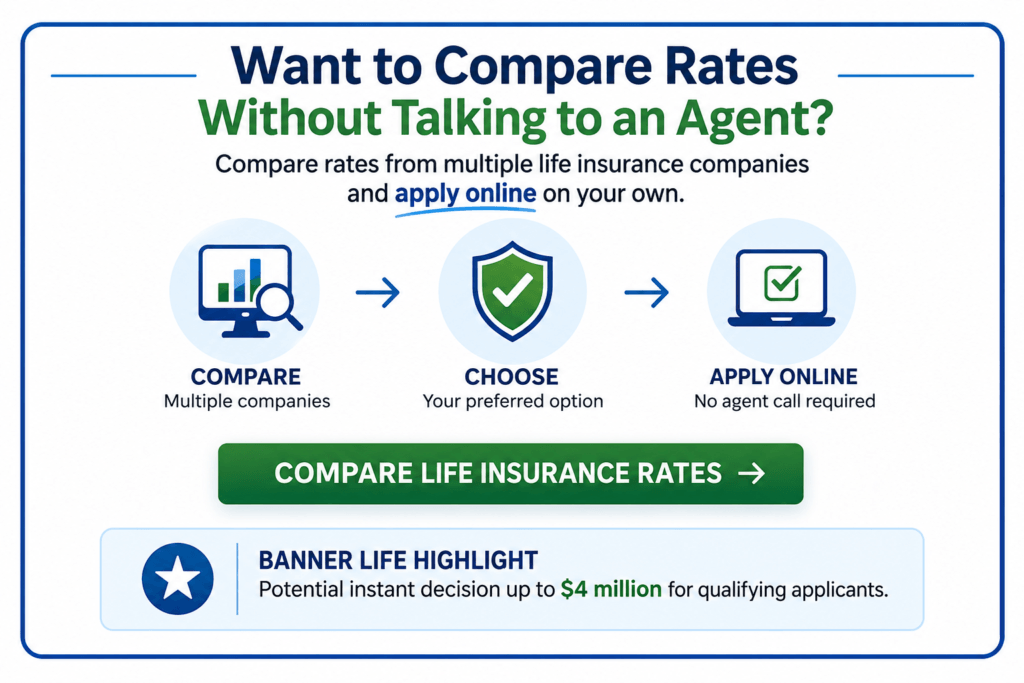
For qualifying applicants ages 20 to 60, Banner has offered accelerated underwriting for coverage amounts well above $250,000, including up to $4 million through eligible programs. Applicants ages 61 to 70 may also have access to smaller no-exam coverage amounts, depending on the product and current underwriting requirements.
If you’re relatively healthy and looking for a $250,000 term policy, Banner is one of the companies I would consider comparing.
Ethos Life
Ethos offers up to $3 million in term life insurance through an online application, with no medical exam required for eligible applicants.
You can apply for a $250,000 life insurance policy without speaking with an agent, and many applicants receive a decision within minutes.
Pacific Life
Pacific Life offers accelerated-underwriting opportunities through eligible term life insurance products.
For qualifying applicants, the company may waive the medical exam based on age, coverage amount, health history, and available underwriting information.
Pacific Life may be worth comparing if you’re looking for a traditional term policy with a streamlined application process.
Protective Life
Protective also offers accelerated-underwriting options for eligible term life insurance applicants.
Depending on your age, health history, and the product selected, you may qualify for $250,000 in coverage without completing an exam.
As with other carriers, the company may request additional medical information if it cannot make a decision using the information already available.
What About Other Insurance Companies?
Companies such as Lincoln Financial, Assurity, and other established insurers may also have programs worth comparing.
The important point is that no single company is automatically the best choice for everyone. One insurer may offer competitive rates for a healthy applicant, while another may be more favorable toward certain medications, medical conditions, or lifestyle factors.
If you’re in good health, pricing and application convenience may matter most. If you have health issues, selecting the right insurer can matter much more than finding the lowest advertised premium.
Important: Accelerated-underwriting programs, eligible ages, face amounts, and product availability can change. Confirm current carrier requirements before applying.
Who Can Qualify for $250,000 of No-Exam Life Insurance?
Healthy adults, typically between ages 18 and 60, have a good chance of qualifying for a $250,000 life insurance policy without a medical exam through accelerated underwriting. However, eligibility depends on your age, medical history, medications, lifestyle, and the insurance company’s underwriting guidelines.
You don’t necessarily need perfect health to qualify. Some insurers may approve applicants with well-controlled conditions such as high blood pressure, elevated cholesterol, or mild asthma without requiring an exam.
For example, someone taking medication for high blood pressure may qualify if their condition is well-managed and they have no significant complications. Another applicant with the same condition may need additional medical records or an exam, depending on their overall health.
Does Your Income Matter When Applying for $250,000?
Yes. Insurance companies may also evaluate whether the coverage amount makes financial sense.
For a $250,000 policy, financial underwriting is generally less involved than for several million dollars in coverage, but insurers still consider the purpose of the insurance.
They may review factors such as:
- Income replacement needs
- Mortgage and outstanding debts
- Family financial obligations
- Existing life insurance
- Business-related insurance needs
- Estate or legacy planning
You don’t necessarily need a high income to qualify for $250,000 in life insurance.
For example, a stay-at-home parent may need coverage because replacing childcare, household management, and other contributions could create substantial expenses for the surviving family.
The amount an insurer approves depends on your individual circumstances and its financial underwriting guidelines.
Is $250,000 in Life Insurance Enough?
A $250,000 life insurance policy may be enough if you have limited debt, fewer financial dependents, or existing savings and insurance coverage. However, for families who rely heavily on one person’s income, $250,000 may not provide enough financial protection.
For example, someone earning $80,000 annually would need $400,000 just to replace five years of gross income. That doesn’t include paying off a mortgage, covering future education expenses, or meeting other financial obligations.
On the other hand, $250,000 in life insurance may be sufficient for someone approaching retirement who has paid off most of their mortgage and already accumulated substantial savings.
A $250,000 life insurance policy may be a good fit for:
- Couples with two incomes who don’t rely entirely on one person’s earnings.
- Homeowners with smaller mortgages who want to help their families pay off the remaining balance.
- Parents with older children who have fewer years of financial dependency remaining.
- Individuals with existing coverage who want to supplement their employer-provided life insurance.
- People with substantial savings who only need insurance to cover a specific financial gap.
Ultimately, the right amount of life insurance depends on your income, debts, family responsibilities, and the financial resources your beneficiaries would have available.
How Do You Calculate How Much Life Insurance You Need?
A simple way to estimate your coverage needs is to consider your family’s financial obligations and subtract the resources already available.
Income replacement + debts + future obligations + education and other goals − existing assets and life insurance = estimated coverage need.
For example, suppose your family would need $150,000 to replace lost income, $75,000 to pay off debts, and another $50,000 for future expenses.
That adds up to $275,000.
If you already have $50,000 in savings available for these needs, your estimated insurance gap would be $225,000.
In that situation, a $250,000 policy might provide adequate coverage.
Of course, this is only an example. You should also consider how long your family will need support, whether your expenses will change, and which existing assets are realistically available.
What If You Need More Than $250,000?
If you need more coverage, don’t automatically settle for $250,000 just to avoid a medical exam. Many insurers offer accelerated underwriting for much larger amounts.
Depending on your circumstances, you may qualify for a $500,000 life insurance policy or even $1 million without a medical exam.
Start by determining how much coverage you actually need. Then compare the underwriting options available for that amount.
Can Seniors Get $250,000 Life Insurance Without a Medical Exam?
Yes, some applicants over age 60 may still qualify for $250,000 in life insurance without completing a medical exam. However, your options generally become more limited as you get older. Many accelerated-underwriting programs have maximum issue ages, and older applicants may not be eligible for longer term lengths.
For example, someone applying at age 65 may still qualify for a 10- or 20-year term policy with certain insurers, but a 30-year term may no longer be an option. If you need coverage for the rest of your life, permanent insurance may be worth considering.
Don’t confuse traditional $250,000 life insurance with final expense or guaranteed-issue coverage. Final expense insurance generally provides smaller death benefits intended to cover funeral expenses and other end-of-life costs.
If your goal is to leave $250,000 to your spouse, children, or other beneficiaries, traditional term or permanent life insurance may be a better fit, even if it requires additional underwriting.
What If You Don’t Qualify for $250K No-Exam Coverage?
If you don’t qualify for accelerated underwriting, you may still be able to get a $250,000 life insurance policy through traditional underwriting or find another insurer whose guidelines better fit your health history.
Here are a few options worth considering:
- Complete a medical exam: Additional medical information may help the insurer evaluate your health and offer coverage.
- Compare another carrier: Insurance companies evaluate medical conditions differently. One company’s decision doesn’t automatically determine what another will offer.
- Consider a different policy type: Depending on your age and financial goals, term or permanent insurance may provide different underwriting opportunities.
- Adjust your coverage amount: If $250,000 isn’t available through a particular program, a smaller amount may qualify, but consider whether it adequately protects your family.
- Explore simplified-issue insurance: Certain policies require fewer medical steps, but coverage limits and premiums may differ significantly.
The important thing is not to let avoiding a medical exam take priority over getting the right coverage. An independent advisor can help you compare these options and determine which companies may be more favorable toward your particular health situation.
How to Compare Life Insurance Quotes?
When comparing $250,000 life insurance quotes, make sure you’re looking at policies with similar coverage amounts, term lengths, and underwriting assumptions.
A lower advertised premium doesn’t necessarily mean you’ll receive that rate once the insurance company reviews your application. You’ll also want to consider the insurer’s financial strength, policy guarantees, conversion privileges, available riders, and whether the coverage fits your long-term needs.
For example, a 10-year term policy may look attractive because of its lower monthly premium. But if you need protection for another 20 years, choosing the shorter policy could leave you needing new coverage at an older age.
The same applies to no-exam underwriting. A fast application is convenient, but it shouldn’t be the deciding factor if another insurer offers better coverage or a more competitive final rate.
At Abrams Insurance Solutions, we work with these and other top-rated carriers to help clients compare options and find the right policy for their needs. If you don’t like talking on the phone and are in relatively good health, you can compare quotes and apply online without ever speaking to an agent.
Click here to apply without talking to an agent.
FAQs
What is Accelerated Underwriting?
Accelerated underwriting is a faster approval process where the insurance company relies on digital data and a health questionnaire instead of a full medical exam. This often shortens the underwriting process from weeks to days while still providing a meaningful death benefit.
Can I Get $250K Life Insurance With No Waiting Period?
Some accelerated-underwriting policies provide full death benefit coverage once the policy becomes effective, without a graded-death-benefit waiting period. However, coverage doesn’t begin simply because you submit an application. The insurer’s effective-date requirements, exclusions, and contestability provisions still apply.
Can I Get a $250,000 Life Insurance Policy With Health Conditions?
Possibly. Certain controlled conditions, such as high blood pressure, elevated cholesterol, or mild asthma, may still qualify for accelerated underwriting. Eligibility depends on your overall medical history and the insurance company’s guidelines.
Can I Get $250,000 of Life Insurance if I’m Unemployed?
Yes, it’s possible. Insurers may consider household contributions, spousal income, existing assets, childcare responsibilities, and other financial needs when evaluating an application. Approval depends on the circumstances and the insurer’s financial underwriting requirements.
Can I Increase My $250,000 Life Insurance Coverage Later?
You may be able to purchase additional coverage or increase an existing policy if its terms allow. However, additional insurance generally requires underwriting unless your policy includes a specific option to increase coverage without new medical evidence.
Is Simplified Issue Life Insurance the Same as No-Exam Life Insurance?
Not exactly. Simplified issue is a type of no-exam life insurance that requires you to answer basic health questions but skips the medical exam. However, not all no-exam policies are simplified issue; some are guaranteed issue, which don’t ask any health questions at all.
The Bottom Line
Getting a $250,000 life insurance policy without a medical exam is easier than it used to be, thanks to accelerated underwriting programs offered by several major insurance companies. For qualifying applicants, these programs can provide competitive rates and a streamlined application process without requiring blood work or a physical exam. Having the right amount of coverage matters as much as how quickly you can get approved.
Start by calculating what your family would need financially. Then compare insurance companies based on your age, health, budget, and available underwriting options.
Ultimately, skipping the medical exam is a convenient benefit. The real goal is making sure your family has the financial protection it needs at a price you can comfortably afford.
Next Steps
At Abrams Insurance Solutions, we have access to over 80 top-rated life insurers and know which companies consistently offer the most affordable policies, whether you’re looking for a life insurance policy with no medical exam or a fully underwritten option.
Our mission is simple: to help you secure the coverage you need at the lowest possible premium. If you have questions about life insurance that doesn’t require a health exam, call us today at 858-703-6178. You can also see instant quotes anytime by using the INSTANT QUOTES form on this page.


